Anthroposophic nursing adds a deeper dimension to palliative care, inviting us to see the whole person, not just their illness. When we care for someone, we perceive them through the lens of the fourfold human being: the physical body, the etheric (or life) body, the soul body, and the “I”, the essence of who that person truly is. Through this lens, the person is no longer simply a set of symptoms to be managed. We are meeting them as the sum of everything they have lived: their experiences, their relationships, their personality, their loves and their dislikes.
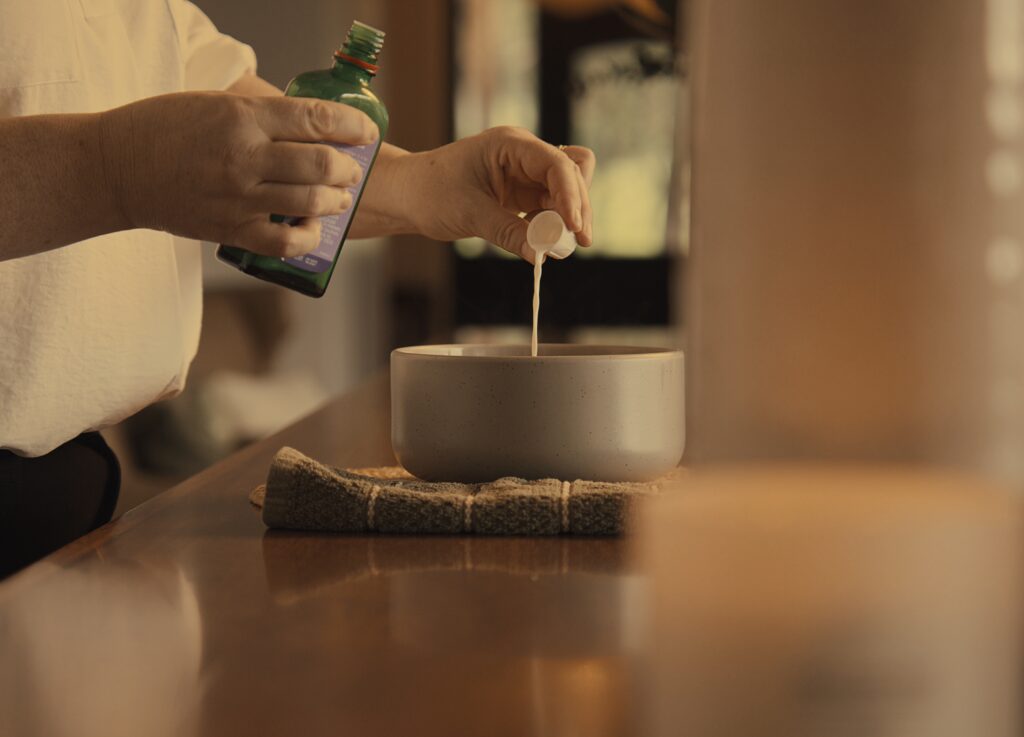
This way of caring asks us to sense where a person is in each moment, and to respond with nursing therapies that meet their needs from a fourfold perspective. This might be a warm footbath, rhythmical oiling, or a compress to support the person’s warmth and inner processes. Each draws on a knowledge of natural substances, whose qualities work together with the nurse’s intention and gesture in care. Our framework offers a broad understanding of the whole human being, which allows us to work alongside any cultural or spiritual tradition. At any point, and generally as capacity lessens, a person may wish for a priest or spiritual companion to tend to their spiritual needs, and we help them make that connection. We believe the soul continues to develop right up to the moment of death and beyond, and that the same is true for those who share the journey alongside them. This is why our care continues after death, through vigil and after-death care.
Anthroposophic nursing does not replace conventional care; it extends it. Grounded in our conventional nursing training and an understanding of allopathic medicine, we are able to thread the two together, interweaving anthroposophic therapies alongside medical treatment and symptom management. The result is care that is both clinically sound and deeply nourishing for the whole person.
As a person enters the dying phase, their senses become heightened. They can feel the truth, or lack of it, in every word and every action around them. This is why presence and authenticity matter so much at the bedside.
For this reason, our training as anthroposophic nurses is as much about inner work as it is about clinical skill. Alongside studying the teachings of Rudolf Steiner and the world of nature, rhythm and life’s transitions, we are asked to explore and develop ourselves. We work through our own biography and come to understand our true purpose. In accompanying the dying, the nurse becomes a bridge between the earthly and spiritual worlds, and that role asks us to be grounded in who we are.
This inner journey deepens our sensitivity and intuition, and in turn strengthens our capacity to support people with care, dignity and truth as they cross the threshold.